Menu

Lares Trek to Machu Picchu – 3 Days / 2 Nights BM-2119

4.8 Based on 179 Reviews 3 Days / 2 Nights
15 days Duration
Small Group Tour Usually 8-12 participants
16 people Maximum group size
16 - 99 years Age range for participants
English Guide language
Moderate Involves sustained activity requiring a reasonable level of fitness and endurance.

Overview

Three days is enough to walk through the most culturally dense trekking route in the Cusco region, sleep in one of the most isolated indigenous communities in the Andes, cross a 4,700-meter pass, and arrive at Machu Picchu on foot through terrain most visitors never see.

The 3-Day Lares Trek covers the essential route: the Lares valley, the Cancha Cancha community, the Pachacutec Pass, the encounters with Quechua-speaking herders on the descent, the Seven Waterfalls, and a full guided tour of the citadel. What it does not include — and we’ll be direct about this — is the Lares Hot Springs and the Pisac ruins visit. Those require the extra day that the 4-day version provides.

This version is for travelers with a tighter schedule who still want the real Lares experience, not a softened version of it. The route is identical in its most important stretches. The communities are the same. The pass is the same altitude. The horseman team and the guide are the same caliber.

Machu Picchu Peru Lovers runs this route with a maximum of 8 hikers. This particular trek tends to run in small groups of 2 to 4 — which, on a culturally immersive route like this, works in your favor.

Machu Picchu tickets are government-controlled and limited. Book with adequate lead time for your preferred dates.

Difficulty: Challenging | Max Altitude: 4,700 m (15,420 ft) | Distance: 21 km / 13 mi (hiking days) | Group Size: Up to 8 people | Transport: Private van · Train · Bus

Highlights

  • Cancha Cancha Community (3,900 m) — the first night’s camp and the emotional core of this trek. No road access. Electricity connected in December 2019. A self-sustaining community that has operated the same way for centuries, and an evening that includes a local family visit, Quechua interpretation, and an Inca constellation session under an Andean sky with no light pollution in any direction.
  • Pachacutec Pass (approx. 4,700 m) — the highest point of the route and the most demanding section. Day two climbs steeply northeast from camp through glacier views, high-altitude lakes, and open mountain terrain. At the top: three snowcapped peaks visible simultaneously, glacial rivers running white through boulder fields below. Caracara falcons and Andean geese in the air above. Cold, exposed, and completely worth the effort.
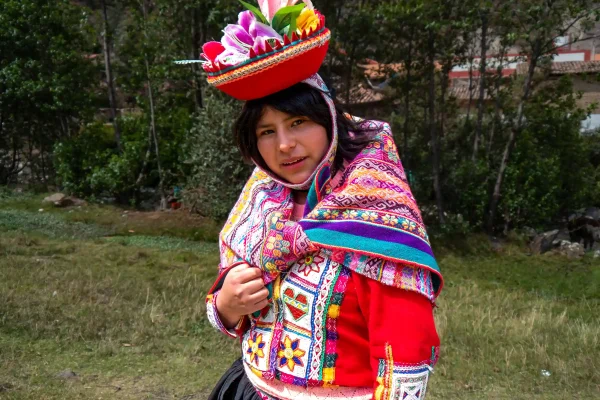
  • Quechua encounters on the descent — the 3-hour descent from the pass follows an isolated trail where highland herders in traditional dress move with their llamas and alpacas through the same seasonal routes they’ve used for generations. They engage in Quechua. Your guide translates. These are the moments people on this trek name specifically when they describe it to others.
  • The Seven Waterfalls — a series of cascades visible from the trail as the group approaches the Quiswarani area. They arrive late on the hardest day, at the right psychological moment.
  • Machu Picchu with context — the day three citadel visit follows two days in the living Andean world. The agricultural terraces, the water systems, the ceremonial structures — they carry different weight when you’ve just spent two days in the communities and valleys that existed in direct relationship with this place.
  • A route that most people never walk — the Lares valley sees far fewer trekkers than the Salkantay or the Inca Trail. Even in high season, you will occasionally encounter another group — not a parade. Machu Picchu Peru Lovers selects campsites specifically to keep the group in quieter terrain.
  • Three days, real experience — this is the most honest version of the Lares route available within a 3-day window. It does not pretend to be the 4-day tour. But it delivers the Cancha Cancha night, the pass, the cultural encounters, and Machu Picchu — which is what most travelers booking this route are actually looking for.

Itinerary

Day highlight: Arriving at Cancha Cancha — one of the most isolated communities in the Cusco region — and spending the evening with a local family under the Inca constellations

  • Distance: 9 km / 5.6 mi
  • Hiking time: Approx. 3.5 hours
  • Altitude: approx. 2,800 m (Huaran trailhead) → 3,900 m (Cancha Cancha camp)
  • Difficulty: Moderate — a steady, gradual ascent; a good first day
  • Terrain: Dirt trail along the Andean valley, ascending river corridor, some rocky sections in the upper approach to Cancha Cancha
  • Transport: Private van from Cusco hotel (5:00 AM pickup) → Huaran trailhead → on foot

The van picks up from your Cusco hotel at 5:00 AM, heading toward the Sacred Valley. The drive to Huaran takes approximately one hour. At Huaran, the horsemen and horses are ready. Duffel bags are handed over. Boots on, packs adjusted.

The 3.5-hour ascent follows the valley floor and gradually climbs toward Cancha Cancha through open Andean terrain — highland grasslands, river crossings, and widening mountain views as altitude increases. The morning is cool and the pace is moderate. Lunch is served along the river, prepared by the cook team at a natural rest point.

Cancha Cancha (3,900 m / 12,800 ft) — the camp and the community. No road leads here. The track in from Huaran is on foot or horseback only. Electricity arrived in December 2019 — before that, the community operated by firelight and natural light, as it had for centuries. The agricultural systems, the family structures, the social rhythms — these are not preserved for tourism. This is how people live here.

After settling into tents and afternoon tea, the local family visit begins. Your guide translates Quechua throughout the interaction — how the family structures its agriculture across the growing seasons, how the children are educated, what changes in the last decade have meant for daily life. The conversation goes where it goes.

After dinner, the guide leads the Inca constellation session outside in the dark. The Andean constellation system reads the dark patches between stars — not the star clusters of European astronomy, but the dark cloud constellations, which the community uses to time planting, harvest, and seasonal movement. At 3,900 m with no city light within range, the sky is a different object than the one most people are accustomed to looking at.

Temperatures overnight drop to around 3–5°C. Dress in layers for the evening outside the tent.

Meals: Breakfast · Lunch (riverside) · Afternoon Tea & snacks · Dinner | Accommodation: Camping with bathroom facilities at Cancha Cancha

Day highlight: The Pachacutec Pass at 4,700 m, the herder encounters on the descent, and the Seven Waterfalls — followed by the train to Aguas Calientes

  • Distance: 12 km / 7.5 mi (hiking) + 2-hour van transfer + train
  • Hiking time: Approx. 7 hours
  • Altitude: 3,900 m (start) → approx. 4,700 m (Pachacutec Pass) → 3,700 m (Quiswarani)
  • Difficulty: Challenging — the longest and hardest day; a sustained morning ascent, a 3-hour descent, and then significant additional travel to reach Aguas Calientes
  • Terrain: Rocky, steep ascent to the pass; exposed high-alpine terrain at the top; long descent on dirt trail through isolated highland valleys; some loose stone sections
  • Transport: On foot to Quiswarani → private van, Quiswarani to Ollantaytambo (approx. 2 hours) → train, Ollantaytambo to Aguas Calientes

Hot tea or coffee in the tent before breakfast. This is the longest day and the most demanding. It requires an early start and moves at a sustained pace throughout.

The morning climb heads northeast from Cancha Cancha toward Pachacutec Pass (approx. 4,700 m / 15,420 ft). The ascent is intense — steep, rocky, and long. The vegetation thins rapidly above 4,200 m. Above 4,400 m, the thin air is clearly felt. The guide sets the rhythm; follow it.

At the pass: the Salkantay, Colquecruz, and surrounding glacier peaks are visible on clear mornings. Glacial lakes sit in the valleys below. Glacial rivers run pale white with minerals through the boulder fields. Caracara falcons work the thermals. Andean geese move through the terrain below the pass. Take the time at the top before starting down.

The three-hour descent follows an isolated trail that sees very few outsiders. This is where the route crosses paths with the highland herding life: indigenous people in traditional dress, moving with llamas and alpacas through the seasonal transhumance routes that have defined this valley for centuries. Your guide translates the Quechua exchanges in real time. These encounters are not arranged. They are what the trail looks like.

Near the end of the descent, the Seven Waterfalls appear — a series of cascades dropping across the mountain face above the valley. A natural endpoint for one of the longest days on the route.

At Quiswarani (3,700 m), the private van is waiting. The 2-hour drive to Ollantaytambo follows the valley road through the Sacred Valley. Time to rest in the vehicle, eat any remaining snacks, and decompress from the day.

The train from Ollantaytambo to Aguas Calientes follows the Urubamba River through the canyon. Check in to the hotel. Dinner in town.

A practical note: day two is a genuinely long day — 7 hours of hiking at altitude followed by 2 hours in the van and the train journey. Expect to arrive in Aguas Calientes in the late evening. Rest is the priority.

Meals: Breakfast · Lunch (trail) · Afternoon Tea & snacks · Dinner (Aguas Calientes, restaurant) | Accommodation: 3-star hotel in Aguas Calientes — Ferre Hotel Machu Picchu or similar (private room, private bathroom, hot shower, buffet breakfast, Wi-Fi)

Day highlight: The Machu Picchu citadel tour after two days in the Andean communities that existed in direct relationship with this place

  • Difficulty: Easy
  • Terrain: Stone paths within the citadel
  • Transport: Bus to Machu Picchu → Bus back to Aguas Calientes → Expedition or Vistadome train to Ollantaytambo → Private van to Cusco

Breakfast at the hotel, then one of the first buses up to Machu Picchu. The 25-minute switchback ride. The citadel at early morning before the midday groups arrive.

The two-hour guided tour covers the agricultural, residential, and religious sectors: the Temple of the Sun, the Intihuatana stone, the Room of the Three Windows, the residential compounds and the terracing systems. Your guide — who spent the previous two days interpreting Andean highland culture for you — connects what you’re seeing at Machu Picchu to what you saw and experienced in the Lares valley. The agricultural terraces are not abstract now. The community systems are not theoretical.

Free time after the guided tour for personal exploration. Those who booked Huayna Picchu Mountain in advance check their entry window — the climb is done independently, involves rope-assisted sections and narrow stone steps, takes approximately 45–60 minutes up. Not recommended for those with a fear of heights.

Walking poles and large backpacks are not permitted inside Machu Picchu. Stored at the entrance control point.

Bus back to Aguas Calientes in the afternoon. Free time for lunch (own expense), the market, the museum, or the thermal baths in town.

The Expedition Train departs at 2:55 PM or 3:20 PM (subject to availability) back to Ollantaytambo. Private van from the station exit to your Cusco hotel.

Arriving approximately 7:00 PM.

Meals: Breakfast (hotel) | Accommodation: Return to Cusco hotel

Get Trip Brochure & Exclusive Discount Download a detailed PDF brochure and unlock special online savings for this trip.
Download

What's Included & Excluded

  • Airport transfer: Cusco airport → your Cusco hotel (notify us of flight details at least 14 days before arrival)
  • Private hotel pick-up in Cusco on day one
  • Private transportation: Cusco hotel → Huaran trailhead (day one) · Quiswarani → Ollantaytambo (day two) · Ollantaytambo → Cusco hotel (day three)
  • Professional English-speaking guide — licensed, Quechua interpreter, academic background
  • Full horseman team: pack horses and mules carrying tents, food, cooking equipment, and personal duffel bags (up to 7 kg per person)
  • Emergency horse for any trekker unable to continue
  • Duffel bag provided at the evening briefing
  • 4-season Eureka Timberline tents — 2 persons per tent
  • Comfortable foam mattresses and pillows
  • Private biochemical toilet tent with seat at the campsite
  • Dining tent with tables and chairs
  • Chef and full cooking equipment
  • All meals as per itinerary: breakfast, lunch, afternoon tea & snacks, dinner on days 1–2; breakfast only on day 3
  • Dinner on day 2 (restaurant in Aguas Calientes)
  • Vegetarian and dietary alternatives available with advance notice
  • Boiled drinking water at every meal; warm water for washing at camp
  • Community visit: Cancha Cancha local family (night one)
  • Inca constellation session at Cancha Cancha (night one)
  • Round-trip train ticket: Ollantaytambo → Aguas Calientes (day two evening) · Aguas Calientes → Ollantaytambo (day three afternoon)
  • 3-star hotel in Aguas Calientes — Ferre Hotel Machu Picchu or similar (private room, private bathroom, hot shower, buffet breakfast, Wi-Fi)
  • Machu Picchu Archaeological Complex entrance ticket
  • Two-hour professionally guided tour of Machu Picchu Citadel
  • 2 bus tickets: Aguas Calientes → Machu Picchu · Machu Picchu → Aguas Calientes
  • Backpack rain cover
  • First-aid kit with emergency oxygen
  • All taxes

  • Lunch in Aguas Calientes on day three (own expense, free time)
  • Lares Hot Springs — (not included in the 3-day version; available with the 4-day Lares Trek)
  • Sleeping bag: $20 USD (available to rent)
  • Air mattress: $20 USD (available to rent)
  • Walking poles: $15 USD per pair (recommended)
  • Personal tent (solo travelers): $30 USD
  • Vistadome train upgrade: $67 USD per person (return only)
  • Huayna Picchu Mountain: $75 USD (must be booked at reservation)
  • Hotel single supplement: $40 USD per night
  • Tips for guide, cook, and horseman team (appreciated but not required)

Customer Reviews

4.8 Based on 179 reviews
5
4
3
2
1
A
Anonymous

Wonderful

Trip went very smoothly and was very well organized. Easy to highlight is Machu Picchu, but our visit of Amantani island on Lake Titicaca was a real interesting and unique experience. Read more.

A
Anonymous

Thoroughly recommended

This was an excellent well-organized tour at a great value with plenty of variety and lots of free time to explore. Read more.

A
Anonymous

A Peruvian Adventure Not to Miss

This was our first trip with Bookmundi and we are extremely happy. From start to finish the experience was excellent. Read more.

A
Anonymous

Great Value

We saw all the highlights, the guides were excellent and the trip flowed nicely. The pacing was just right. Read more.

Read more reviews

Availability

Sun 08 Nov 2026
Wed 09 Dec 2026
Guaranteed departure
From USD 947
Sun 22 Nov 2026
Wed 23 Dec 2026
Filling fast
From USD 947
Tue 08 Dec 2026
Fri 08 Jan 2027
Available
From USD 947
Tue 22 Dec 2026
Fri 22 Jan 2027
Almost sold out
From USD 947
Fri 08 Jan 2027
Mon 08 Feb 2027
Sold out
From USD 947
Sold out
Fri 22 Jan 2027
Mon 22 Feb 2027
Guaranteed departure
From USD 947
Mon 08 Feb 2027
Thu 11 Mar 2027
Filling fast
From USD 947
Mon 22 Feb 2027
Thu 25 Mar 2027
Available
From USD 947
Mon 08 Mar 2027
Thu 08 Apr 2027
Almost sold out
From USD 947
Mon 22 Mar 2027
Thu 22 Apr 2027
Sold out
From USD 947
Sold out
Thu 08 Apr 2027
Sun 09 May 2027
Guaranteed departure
From USD 947
Thu 22 Apr 2027
Sun 23 May 2027
Filling fast
From USD 947

Good to Know

Weeks to months before the trek:

  • Book Machu Picchu entrance tickets well in advance — particularly for May through September. Daily capacity is government-controlled and limited.
  • Begin physical preparation. Day two involves a sustained ascent to 4,700 m followed by a 3-hour descent — a total of 7 hours of hiking at altitude. Regular walking with elevation gain in the weeks before departure is the practical preparation.
  • If you are over 60, or have any cardiovascular, respiratory, or joint conditions, consult your physician before booking. This is a challenging-rated route.
  • Get travel insurance covering high-altitude trekking and emergency medical evacuation.
  • Consider the 4-day version if your schedule allows. The Lares Hot Springs, the Pisac ruins, and the additional day in the valley are real additions. If the extra day is available to you, the 4-day is the more complete experience. The 3-day is the right choice when it isn’t.

A few days before:

  • Spend at least 2 to 3 days in Cusco (3,350 m) or the Sacred Valley before day one. Day two reaches 4,700 m. Arriving there without any acclimatization time makes the hardest day significantly harder.
  • Drink water and coca tea consistently during acclimatization days.
  • Attend the briefing at our Cusco office the evening before departure. Pack the duffel bag that evening — the van leaves at 5:00 AM.
  • Duffel limit: 7 kg. Sleeping bag approx. 2 kg + sleeping pad approx. 1 kg = approximately 4 kg for clothing and personal gear.

During the trek:

  • Day two is the long one. Start at the pace the guide sets — not ahead of it. The pass is the midpoint, not the end. There is still a 3-hour descent plus 2 hours of driving after reaching the top.
  • Drink water consistently. Dehydration at altitude compounds exhaustion faster than at lower elevations.
  • At Cancha Cancha: follow the guide’s lead during the family visit and the constellation session. Ask questions freely — the guide is there to facilitate exactly that kind of exchange.
  • Do not photograph community members without asking the guide first.
  • On the descent, let the herder encounters happen naturally. Don’t rush through them to reach the van faster. These are the moments people remember.
  • Carry Peruvian soles for tips and purchases in Aguas Calientes on day three.

On payments:

  • Deposit: $211 USD per person — non-refundable from the moment of payment. Machu Picchu tickets cannot be changed or transferred after purchase.
  • Balances payable in cash (USD or soles) at our Cusco office. Online payment via VISA or PayPal incurs a 5.5% fee.
  • Contact us immediately if dates need to change — the earlier, the more options exist.

Group Service — What It Includes and Who It’s For

Option Price Per Person
Standard group rate $497 USD
Groups of 5 or more $467 USD (save $30 per person)

Who group service is for:

Group service is the right option for solo travelers, couples, and small groups comfortable walking with up to 8 people from different parts of the world on a shared schedule. In practice, this trek tends to run with 2 to 4 hikers — smaller than the 4-day version — which makes the shared-group experience even more relaxed than on higher-demand routes.

What traveling in group service looks like day to day:

  • The guide manages pace for the group collectively. On a culturally driven trek like the Lares, this tends to be natural — the pace at community interactions is set by the interaction itself, not by an aggressive schedule.
  • Meals are prepared for the full group. Dietary restrictions and vegetarian options are accommodated with advance notice.
  • The dining tent, camping setup, and toilet tent are shared among all group members.
  • The Machu Picchu tour on day three runs for the whole group.
  • The train and van on day two are booked for the group collectively.

For solo travelers: Contact our reservations team to join an existing departure or to open a new group. A minimum of 2 participants is required to run a departure.

An honest note about this trek’s demand: The 3-day Lares Trek is less booked than the 4-day version — which means groups are often smaller and more intimate. A group of 2 to 3 people walking the Lares valley is a quieter, more personal experience than an 8-person group. For many travelers, the lower demand on this route is an advantage.

Documents:

  • Original passport — same one used at booking. Checked at the Machu Picchu entrance and when boarding the train.
  • Valid student card if relevant
  • Travel insurance documentation
  • Personal medical prescriptions

For your duffel bag (carried by pack horse — max 7 kg):

2 kg sleeping bag + 1 kg sleeping pad = approx. 4 kg remaining

  • 2 hiking t-shirts (moisture-wicking)
  • 2 pairs of hiking pants (quick-dry)
  • 4 sets of undergarments
  • 3 pairs of hiking socks
  • Thermal base layers — Cancha Cancha night reaches 3–5°C
  • Fleece mid-layer
  • Down jacket or heavy insulating layer
  • Waterproof gloves
  • Comfortable camp shoes or sandals
  • Quick-dry towel
  • Bathing suit — (optional: if you have time for the Aguas Calientes thermal baths on day three)
  • Sleeping bag rated to -15°C minimum — available to rent for $20 USD

For your day pack (carried by you on the trail):

  • Daypack 30–40 liters
  • Water: 2–3 liters in reusable bottles (disposable plastic is not appropriate in these communities)
  • Comfortable hiking boots with ankle support
  • Headlamp with spare batteries — essential for early morning and camp use
  • Sun hat and sunglasses
  • High-SPF sunscreen
  • Wool hat and gloves
  • Rain jacket and waterproof pack cover
  • Fleece layer
  • Snacks: energy bars, chocolate, dried fruit
  • Personal first-aid kit: blister treatment, bandages, pain relief
  • Personal medications
  • Camera — no electricity on trail days 1–2; bring a power bank
  • Hand sanitizer
  • Toilet paper in a sealed bag
  • Extra cash (Peruvian soles) for tips and Aguas Calientes purchases

Additional notes:

  • Walking poles are recommended for the Pachacutec Pass descent. Available to rent for $15 USD per pair.
  • Walking poles and large backpacks are not permitted inside Machu Picchu.
  • If you require specialized equipment — professional photography gear, mobility aids, or items needing special handling — notify our reservations team in advance.

Airport transfer

Cusco airport to your hotel is included. A Machu Picchu Peru Lovers representative meets you at the arrivals terminal exit with a sign bearing your name. They wait outside — exit the arrivals hall to find them. Send your flight details at least 14 days before arrival.

Hotel pick-up on day one

Pick-up from your Cusco hotel at 5:00 AM on day one. Confirm your hotel name and room number at the evening briefing.

Luggage storage

Main luggage stays in Cusco at your hotel or our office during the three days. Pack only what goes into the duffel bag and day pack.

Payment conditions

  • Deposit: $211 USD per person — required at booking to purchase Machu Picchu tickets. Non-refundable from the moment of payment.
  • Machu Picchu tickets are issued against your passport and cannot be changed or transferred after purchase.
  • Balances payable in cash (USD or Peruvian soles) at our Cusco office. Online payment via VISA or PayPal incurs a 5.5% service fee.
  • Passport changes: If you renew your passport or change your name between booking and departure, a name or number update costs $25 USD per person. If you choose not to pay the fee, bring both old and new passports — both will be required at the train and Machu Picchu entrance.

Return from Machu Picchu to Cusco

Day three return: bus from Machu Picchu to Aguas Calientes → Expedition Train at 2:55 PM or 3:20 PM → Ollantaytambo → private van to Cusco hotel, arriving approximately 7:00 PM.

Optional upgrade: Vistadome Train for $67 USD per person — panoramic overhead glass, snack service, on-board cultural performance. Runs to Poroy (near Cusco), private van for the final 25 minutes. Must be requested in advance.

Hotel drop-off in Cusco is included. For Sacred Valley accommodation (Ollantaytambo, Urubamba), coordinate at the time of booking.


Availability

The 3-day Lares Trek is available year-round on any date, with a minimum of 2 participants.

No government trail permits are required for the Lares route. What is government-controlled is the Machu Picchu entrance ticket on day three:

  • For May through September departures, book 2 to 3 months in advance for the Machu Picchu entrance specifically.
  • Last-minute bookings are sometimes possible — contact our reservations team directly by phone to confirm current availability. Do not rely on checking online.
  • Machu Picchu tickets cannot be changed or transferred after purchase.

This trek tends to attract smaller groups of 2 to 4 people compared to higher-demand routes. That characteristic is not a downside — it’s one of the reasons the Lares valley experience is more personal than most.

For solo travelers: Contact us to join an existing departure or to open a new group. We will match solo trekkers with compatible departures where possible.


Additional Information

A direct note on what this route does and does not include

The 3-day Lares Trek skips two elements present in the 4-day version: the Pisac Archaeological Site (visited on day one of the longer route) and the Lares Hot Springs (reached on day three of the longer route). These are real differences and worth naming clearly.

The Lares Hot Springs specifically — natural volcanic thermal pools at 3,100 m, used by Andean communities for centuries — require a full extra day of hiking to reach. They are simply not achievable within the 3-day itinerary without compressing the community experience on the pass days. If the hot springs matter to you, the 4-day is the right tour.

What is fully present in the 3-day: the Cancha Cancha community night, the Inca constellation session, the Pachacutec Pass, the herder encounters, the Seven Waterfalls, and a guided tour of Machu Picchu. These are the core of the Lares experience.

Trains to Machu Picchu

The train is used on both days two and three:

  • Day 2 evening: Ollantaytambo → Aguas Calientes. Follows the Urubamba River through the canyon as the elevation drops into cloud forest.
  • Day 3 return: Expedition Train — comfortable seating, canyon views. Included. · Vistadome ($67 USD extra, return only) — panoramic glass, snack service, cultural performance. Runs to Poroy, private van for the final 25 minutes.

Accommodation in Aguas Calientes

One night at the included 3-star hotel — Ferre Hotel Machu Picchu or similar. Private room, private bathroom, hot shower, buffet breakfast, Wi-Fi.

Upgrade options: La Cabaña ($40), Tierra Viva ($70), El Mapi ($120). Additional nights from $60 USD per person depending on availability.

Transport summary

  • Day 1: Private van, Cusco → Huaran. On foot to Cancha Cancha.
  • Day 2: On foot, Cancha Cancha → Quiswarani. Private van, Quiswarani → Ollantaytambo. Train, Ollantaytambo → Aguas Calientes.
  • Day 3: Bus, Aguas Calientes → Machu Picchu. Bus return. Train, Aguas Calientes → Ollantaytambo. Private van → Cusco hotel.

Travel Restrictions

Physical fitness requirements

The 3-day Lares Trek is classified as challenging. Day two — the hiking core of the route — involves 7 hours of walking with a sustained ascent to 4,700 m followed by a long rocky descent, plus additional travel time to reach Aguas Calientes.

  • Regular physical activity is necessary before this trek. A long day walk with significant elevation gain (15 km / 9 miles) is a practical preparation benchmark.
  • Travelers over 60, or with any cardiovascular, respiratory, or joint conditions, must consult their physician before booking. The Pachacutec Pass at 4,700 m is among the highest points reached on any Machu Picchu approach trek.
  • Spend 2 to 3 days acclimatizing in Cusco (3,350 m) before day one. This is not optional advice — it meaningfully affects how the pass day goes.
  • If you are unable to continue on the trail for health reasons, Machu Picchu Peru Lovers will assist in reaching the nearest accessible point. Emergency oxygen is carried on all departures. An emergency horse is included at no extra cost. In serious cases, helicopter evacuation can be arranged at the trekker’s expense. Travel insurance covering this is strongly recommended.
  • There are no refunds for trekkers unable to complete the route.

Cultural conduct

The Lares Trek passes through living indigenous communities. Practical conduct guidelines:

  • Photography: Always ask the guide before photographing community members. The guide will navigate this with the families appropriately.
  • Children: Engage naturally, but avoid giving money, sweets, or gifts directly to children. It creates dynamics that affect how the community relates to future visitors. The guide will advise on appropriate interaction.
  • Respect the rhythms of the community. Cancha Cancha is not a set piece for tourism. The family visit is a real interaction with real people. Treat it accordingly.

Strikes and demonstrations

Strikes and demonstrations are common in Peru and can affect road access and train services. We will always try to keep the trip as originally planned. If tours must be changed or canceled due to civil disruption, our operations team coordinates directly with you. Your safety drives all such decisions.

Lost items

Pay attention to your belongings at camp, in the van, on the train, and in Aguas Calientes. Once the horses move ahead or transport leaves a location, retrieval is not practical. You are responsible for your own items throughout the tour.

Recommended vaccinations, packing tips, altitude advice and local currency information are shared in your pre-departure pack.
Lares Trek to Machu Picchu – 3 Days / 2 Nights

Do you need help from our trip consultants?

If you have a question about this or any other trip, our travel experts are ready to help with dates, availability and private options.

Contact us

Why Book with Machu Picchu Peru Lovers

  • Trips managed by local experts
  • No credit card or booking fee
  • Personalized small group tours
  • Best price guaranteed
  • 100% financial protection
  • 24/7 trip advisors with a love of travel