Wonderful
Trip went very smoothly and was very well organized. Easy to highlight is Machu Picchu, but our visit of Amantani island on Lake Titicaca was a real interesting and unique experience. Read more.
The Cusco City Tour Half Day gives you the first real look at the Inca capital: its temples, stone walls, water channels, ceremonial spaces, and the places where Andean and Spanish history meet in the same streets. In only a few hours, you move from the heart of the city to the hills above Cusco, where some of the most important archaeological sites still guard the old capital.
You will walk through Qoricancha, once the most important temple dedicated to the Sun, and then continue to Sacsayhuaman, the great stone complex overlooking Cusco. From there, the route continues to Q’enqo, Puka Pukara, and Tambomachay, each with a different role in Inca ritual, administration, and water symbolism.
This tour is a smart first step for travelers arriving in Cusco. It helps you understand the city before going to the Sacred Valley, Rainbow Mountain, the Inca Trail, or Machu Picchu.
With Machu Picchu Peru Lovers, the tour is organized with hotel pick-up, professional guiding, private transport, and a clear route through the most important sites near the city.
Your guide picks you up from your hotel in Cusco to begin the tour of the old Inca capital. The route starts in the city center, where modern Cusco still sits directly over Inca foundations.
The first stop is Qoricancha, also known as the Temple of the Sun. This was one of the most sacred places in the Inca world. The Spanish later built the Santo Domingo Convent over the Inca temple, creating a powerful contrast between two periods of history. Inside, you can see fine Inca stonework, colonial architecture, and religious art linked to the Cusco School.
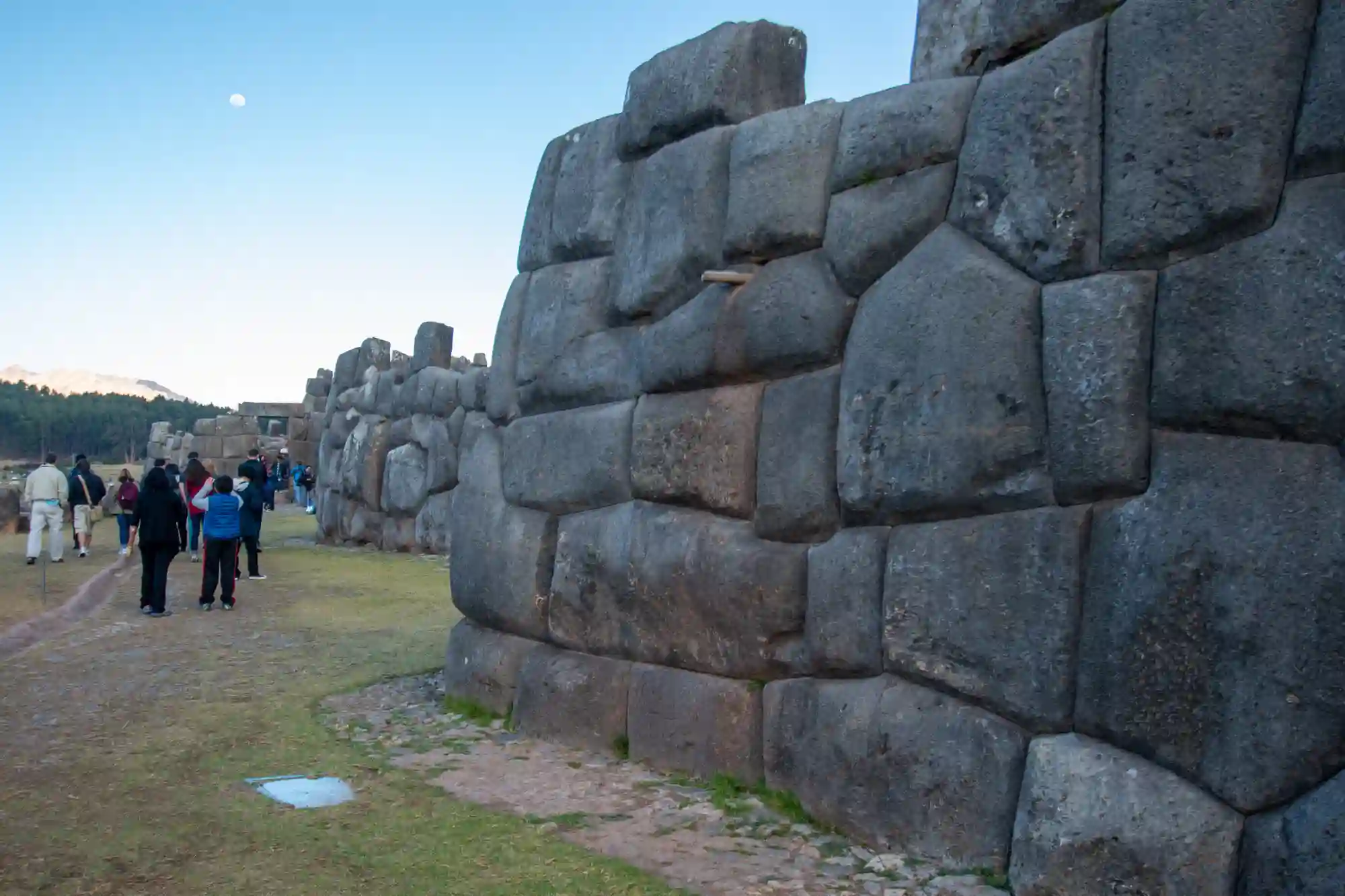
After Qoricancha, you continue by tourist van toward the hills above the city. The next stop is Sacsayhuaman, one of the most impressive archaeological sites near Cusco. The site is known for its huge stone blocks, zigzag walls, and wide open spaces. From here, you also get a strong view of Cusco below.
The tour then continues to Q’enqo, a site carved into natural bedrock. You will see stone channels, caves, and ritual areas that show how the Incas used natural formations for ceremonial purposes.
Next, you move to Puka Pukara, often translated as the Red Fortress. Although its exact function is still debated, it may have served as a control point, resting place, or administrative area along an important route.
The final archaeological stop is Tambomachay, a site linked with water. Its channels, fountains, and stonework show the Inca attention to water movement and ritual design.
After the guided route, private transport takes you back to your hotel or a central area in Cusco, according to the confirmed logistics.
Day Highlight: Understand Cusco through its most important Inca and colonial sites in only half a day.
Technical Details
Qoricancha means “Golden Enclosure.” During Inca times, it was the most important temple dedicated to the Sun. Its walls were once covered with gold sheets, which were later removed during the Spanish conquest.
Today, the site shows the meeting of two worlds: precise Inca stone walls and the colonial Santo Domingo Convent built above them. Qoricancha also worked as an astronomical and ceremonial center, where priests observed celestial movements and important seasonal events.
Sacsayhuaman sits above Cusco and is one of the most powerful Inca constructions near the city. Its stone walls are made with enormous blocks, some weighing many tons, fitted together with striking precision.
The site is often called a fortress, although many researchers believe it also had a ceremonial function. Cusco was planned in the form of a puma, and Sacsayhuaman is often linked with the head of that symbolic city plan.
The area is also used for Inti Raymi, the Sun Festival held every year on June 24.
Q’enqo means “maze” in Quechua. The site includes carved stones, channels, caves, and ritual spaces. Some channels may have been used for ceremonial liquids such as chicha, a traditional corn drink.
Inside the site, travelers can see passageways and an altar-like stone area, which is often linked with ritual practices and offerings.
Puka Pukara means “Red Fortress.” The name comes from the reddish color that the stones can take under certain light.
Although it is commonly called a fortress, its real function may have been more administrative than military. Its location suggests it may have served as a control point, lodging area, or resting place for travelers and messengers.
Tambomachay means “place of rest” in Quechua. It is closely connected with water and may have served as a ceremonial site linked to purification, fertility, or elite rest.
The site has stone channels, aqueducts, and fountains that still move water with impressive precision.
Trip went very smoothly and was very well organized. Easy to highlight is Machu Picchu, but our visit of Amantani island on Lake Titicaca was a real interesting and unique experience. Read more.
This was an excellent well-organized tour at a great value with plenty of variety and lots of free time to explore. Read more.
This was our first trip with Bookmundi and we are extremely happy. From start to finish the experience was excellent. Read more.
We saw all the highlights, the guides were excellent and the trip flowed nicely. The pacing was just right. Read more.
| Group Size | Price |
|---|---|
| 1 to 6 travelers | $150 USD total group price |
| 7 to 12 travelers | $180 USD total group price |
Important: These prices are per group, not per person.
Private service is a strong choice for this tour because it allows better timing, a more comfortable rhythm, and clearer explanations at each site.
Why Private Service Can Be a Better Choice
Entrance fees are not included in the tour price.
To enter Sacsayhuaman, Q’enqo, Puka Pukara, and Tambomachay, travelers must purchase the Boleto Turístico.
Partial Ticket / 1-Day Ticket
General Ticket / 10-Day Ticket
The main archaeological sites such as Sacsayhuaman, Q’enqo, Puka Pukara, Tambomachay, Pisac, Ollantaytambo, Chinchero, Tipon, and Moray are not sold as individual tickets. Travelers must buy the Boleto Turístico.
Payment is normally made in Peruvian soles. Credit cards and US dollars are usually not accepted for these local entrance tickets.
For this tour, discounts depend mainly on the type of Boleto Turístico purchased.
Travelers should bring valid physical documentation if they want to request a reduced rate.
If you have mobility limitations, knee problems, respiratory concerns, or need special assistance, please inform our reservations team before booking.
If you plan to bring professional photography or video equipment, ask in advance because some areas may have restrictions.
Hotel pick-up is included from your accommodation in Cusco. The tour can usually be arranged in the morning or afternoon.
Possible schedules
Please send your hotel name and address in advance so our operations team can organize the pick-up properly.
This is a half-day city tour, so we recommend bringing only a small daypack.
Your main luggage can usually be stored at your hotel. If needed, you may ask our team about storage options before the tour.
A deposit may be required to confirm the tour, guide, and transport.
The remaining balance can be paid according to the method confirmed with our reservations team.
Cash payments in Cusco may help avoid extra card processing fees. Online or card payments may include service fees depending on the payment platform.
Entrance tickets are paid separately in soles and are not included in the tour price.
The Cusco City Tour Half Day can usually be arranged with short notice, depending on guide and transport availability.
For the best coordination, we recommend booking at least 24 hours in advance. Same-day requests may be possible, but they depend on availability.
This tour does not include Machu Picchu tickets and does not require train reservations.
Strikes and demonstrations are common in Peru and may affect roads, city access, or transport routes.
If this happens, our operations team will try to keep your tour as close as possible to the original plan. In some cases, this may require changing the order of sites or adjusting pick-up times.
Tours may also be canceled if safety conditions are not suitable. Any change or cancellation will be coordinated with you by our operations department. Your safety is always the priority.
Please pay attention to your personal items during transport, site visits, and market areas.
You are responsible for your belongings during the tour. Always check your seat, daypack, and personal items before leaving the vehicle or any site.
This tour is considered easy, but Cusco is located at high altitude, and some sites include stairs, uneven ground, and short uphill sections.
Travelers who have just arrived in Cusco should walk slowly and stay hydrated.
Older travelers or travelers with balance, knee, or respiratory concerns should inform us before the tour so the guide can manage the pace more carefully.
Cusco weather can change quickly. Mornings may feel cool, midday sun can be strong, and rain may appear during the wet season.
Bring a light jacket, sun protection, and a rain jacket or poncho depending on the season.
The Cusco City Tour Half Day is one of the best ways to understand the city before taking longer routes in the region.
In a few hours, you see the Temple of the Sun, the stone walls of Sacsayhuaman, the carved spaces of Q’enqo, the route control point of Puka Pukara, and the water channels of Tambomachay.
With Machu Picchu Peru Lovers, the tour is handled with local guidance, private transport, clear timing, and a route designed to give you a strong first connection with Cusco.

If you have a question about this or any other trip, our travel experts are ready to help with dates, availability and private options.